
Walk no 7 – 9th October 2026

We enjoyed a farm walk based at Wick Court, hosted by Farms for City Children and followed by tea, cakes and a discussion. Our theme was childrens’ access to food and nature.
I’m so glad I live in a world where there are Octobers …Lucy Maud Montgomery, Anne of Green Gables
At last the weather has cooled, the trees are turning and there’s a touch of autumn in the air. Even some rain! We gathered beside one of the ancient oaks at Farms for City Children’s Wick Court, tucked away on the Arlingham Peninsular within a huge loop of the mature River Severn. It’s a secret landscape, full of history and stories.

.

The house dates from the late fourteenth century and was originally a hunting lodge for the Berkeley Estate. More recently the farm was owned and run by the Dowdeswell sisters, famous for holding on to virtually the last of the rare Gloucester cattle, and thanks to pioneers like Joe Henson, Clifford Freeman and cheese-maker Jonathan Crump nurturing these cattle the breed has revived.
In 1998, Farms for City Children took over the farm and began hosting children for a week at a time. Our walk would show us what the children do and see while they are ‘farmers for a week’.
The farm and farmhouse have a magical atmosphere, with the beautiful medieval house surrounded by barns and sheds full of animals and poultry. It’s vibrant and busy, and a world away from city childrens’ lives.
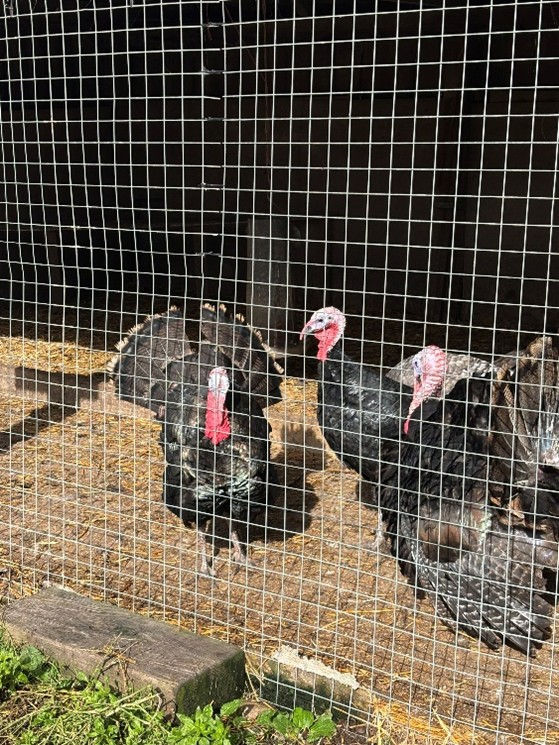

Stuart, the Farm Operations Manager, led us past pens of hens, ducks, geese and turkeys to the first of three old orchards on the farm. Laden with apples and perry pears and grazed by Dorset sheep, we heard how the children harvest the fruit to make juice and feed the animals as part of their daily routine. Returning through a magnificent tithe barn we cut across the field to climb to one of the higher points on the farm with magnificent views across the river Severn. Here were more sheep and cattle, and another orchard bursting with fruit.


Dave, the partner farmer, told us how the children visit his dairy with its robotic milkers and learn how the sheep and cattle – for both dairy and meat – are managed. The aim of their week is to expose them to all aspects of farming and – as far as is consistent with health and safety – to get their hands dirty. There is no sentimentality; the children eat meat and vegetables from the farm all week and learn where their food comes from.
Descending, we entered a field with another magnificent ancient oak. Finding it irresistible, it took six of us with arms outstretched to encircle its enormous trunk, and then we all joined hands around its base. It is at least 600 years old; perhaps older.


In the next field we encountered another group of cattle grazing contentedly – a mix of breeds including Gloucester, British Blue, and some Hereford. We heard how they are slaughtered nearby and sold through the Portway Farm Shop. Cutting across the field we were impressed by the wonderful ridge and furrow, revealing how long it is since the land was ploughed, and it has never been ‘improved’ with artificial fertilisers. In the summer it’s full of meadow flowers including orchids.


Suddenly, a squall of rain hit us and we made our way towards the river, passing another group of Gloucester Cattle and Dorset sheep. We heard that there are still only 19 Gloucester bulls in the world, and Wick Court is fortunate to be loaned one to enable its own small herd to continue. At the river, as the rain stopped, we saw the bird hides used by the children and heard about the seventeenth century tsunami that caused catastrophic damage all up the Severn estuary.


Returning to the farmhouse we loved seeing the pigs – all Gloucester Old Spot, of course – and piglets at various stages of maturity. We watched them being fed before entering the house for delicious tea and cakes.


Stuart and his colleague Natalie, a national fundraiser for the charity, led our discussion and began with a fascinating description of the work of Farms for City Children. Founded exactly 50 years ago by Clare and Michael Mopurgo, Wick Court is the most recently acquired of their three farms: the others are in Devon and Pembrokeshire. Around 3,500 children benefit each year. They travel from inner cities to Wick Court from as far afield as Liverpool and Sunderland, spend 5 days at the farm, and their days follow the rhythm of farming: feeding the animals before breakfast and learning about farming, food and nature.

Up to 36 children sleep in four dormitories and live very different lives from home. They eat what they are given, and are encouraged to try new and unfamiliar foods, whether that is porridge, meat or fruit and vegetables. Unexpected things happen: quiet children shine and become communicative, they discover new skills and interests, and they are unfailingly curious. Children today are more aware than we think about where food comes from but they are full of questions, especially about the natural world. They are encouraged to be courageous, curious, and community-focused.
Natalie told us it costs around £1m a year to run each farm, and the charity aims to subsidise the cost per child to a level of c 50%. There is therefore a constant fundraising need. Schools contribute to the cost through the pupil premium and fundraising and in some cases there is a parental contribution, but the aim is to bring the children with most need, who would benefit most from the farms.
During the discussion it was clear there was huge admiration for the work done by Farms for City Children, and we wondered how the impact could be best captured and spread further – so wonderful and vital is the experience. Natalie said the charity is looking increasingly to influence the school curriculum, because of the huge benefits children gain from access to nature and farming; and each farm is now working with local schools to spread their impact. The challenge of capturing the benefits children receive, and how they develop during the week was discussed at some length – this is key to fundraising.
We discussed childrens’ attitudes to food and farming, and how they respond to both. Their favourite foods (fried chicken!) are often not what they are served at Wick Court, but most respond well to new stimuli. They ask questions about farming, revealing that some have been exposed to prejudices, for example against dairy farming. This led to thoughts about how more school meals could be made from local ingredients, and the challenges of supply chains and the costs that would involve.
We heard about a new community garden, Norton Court, near Tewkesbury and its passion to serve and be helped by the local community – we need more such initiatives. We spoke about the obstacles to eating healthily, including the cost, and the lack of cooking skills, though thankfully these seem to be being taught in schools again.
We heard that the Gloucester Gateway Trust is supported by an innovative funding model which is proving hugely successful, where 3p in every £ generated at Gloucester Services goes into a community fund, which is distributed to local charities. GGT works with people in the poorest parts of Gloucester, and suggested the development of recipe cards to help people know source and buy local food, and ideas for thrifty meals.
One of the main lessons from our discussion was the extent to which childrens’ whole lives can be shaped by this experience, giving them understanding and knowledge which will help them make good choices in life.
We concluded with our heartfelt admiration for Farms for City Children, our thanks to Stuart and Dave for leading our walks, to Natalie and Jasmine for joining us, to the whole team for a delicious tea, and to the High Sheriff’s team for another lovely walk.


Comments